
Steerable Catheter
CDMO
Design & Manufacturing
Envaste designs, validates and manufactures steerable catheters as an ISO 13485 CDMO: 1-way, 2-way and 4-way deflection built on multi-lumen shafts with embedded braid or coil reinforcement, assembled and pouch-sealed in an ISO Class 7 cleanroom.
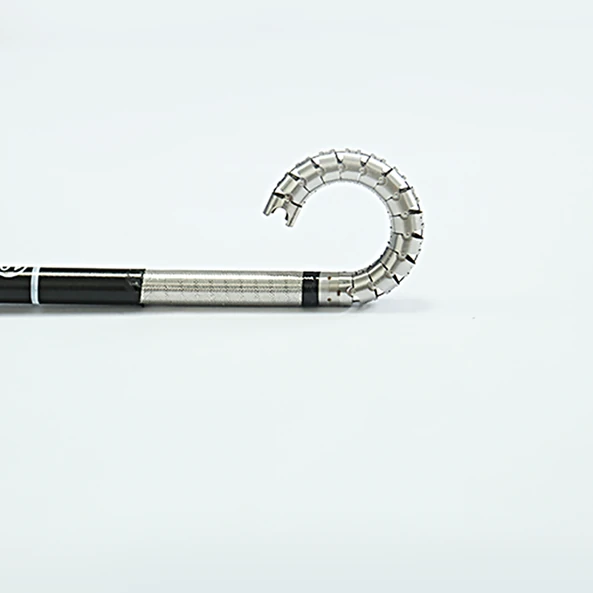
What a Steerable Catheter CDMO Delivers
A steerable catheter is the most integration-heavy device in the catheter family. Deflection, torque response, lumen integrity and tip behaviour each depend on decisions made in the others, so a supplier who only extrudes the shaft, or only cuts the hypotube, cannot be accountable for how the finished device steers. A steerable catheter CDMO takes that accountability: it designs the steering mechanism and the shaft together, validates the assembly process, and manufactures the device under a certified quality system.
Envaste provides this as one programme. Concept and prototyping run in our own lab with stocked Nitinol, Pebax®, nylon and stainless steel; the shaft is extruded, braided or coiled and reflowed on our own lines; deflection and torque are tested against the specification; and design transfer hands the device to our ISO Class 7 cleanroom for assembly, testing and pouch sealing. The design history file is built alongside the device rather than reconstructed afterwards, which is what a 510(k), CE or MDR submission needs.
The platform serves urology and endoscopy, where Envaste manufactures its own single-use range, and the same construction methods support electrophysiology, vascular access, implant delivery and ENT devices. For the manufacturing equipment behind every step, see our catheter CDMO and contract manufacturing capabilities.
Steering Mechanisms: Pull Wires, Pull Rings and Laser-Cut Hypotubes
Deflection is produced by shortening one side of the distal shaft relative to the other. The two mechanisms Envaste builds differ in how that asymmetry is created and in the deflection radius, shaft diameter and torque response they allow.
Pull wires on a metal pull ring
One, two or four pull wires run through dedicated lumens in the extrusion and anchor to a stainless steel pull ring bonded at the tip. Tensioning a wire through the handle bends the compliant distal segment towards that wire. This is the standard construction for 1-way and 2-way catheters and for 4-way devices where two orthogonal pairs give multiplanar steering. The pull-ring anchor and the wire lumens are defined in the extrusion tooling, so the mechanism is built into the shaft rather than added to it.
Laser-cut hypotubes
A stainless steel or Nitinol hypotube is laser-cut with a pattern of slots that leaves a flexible spine on one side. The cut segment bends preferentially in one plane when a pull wire is tensioned, giving a tight, repeatable deflection radius with high torque transmission from a small outer diameter. The pattern pitch and spine width set the stiffness profile along the segment, so the same tube can carry a stiff proximal zone and a highly deflectable tip.
Handles are specified around the mechanism: a thumb lever or rotating knob for 1-way and 2-way devices, two independent controls for 4-way steering, with a locking position where the procedure requires the tip to hold its curve. Deflection angle, radius and the force at the actuator are set in the specification and verified on every development build.
Multi-Lumen Shafts with Embedded Braid or Coil Reinforcement
The shaft decides whether a steerable catheter whips, kinks or ovalises when it is deflected and torqued inside the anatomy. Envaste extrudes the shaft with custom internal channel geometries for the pull wires, the working or guidewire lumen and any irrigation or sensor lines, from 2 Fr to above 30 Fr with precision wall control. Reinforcement is embedded during extrusion rather than applied as a secondary operation, and durometer transitions along the length are extruded in, so the stiff proximal section that carries push and torque meets the compliant distal section without a bonded joint at the transition.
| Process | What Envaste runs in-house | What it controls on a steerable shaft |
|---|---|---|
| Extrusion | Multi-lumen and multi-layer jackets, multi-durometer, 2 Fr to above 30 Fr, radiopaque and lubricious compounding, SPC and IQ/OQ/PQ validation | Pull-wire lumen position and concentricity, wall thickness, stiffness profile |
| Braiding | 16 and 32 carrier braiders, 304 and 316 stainless steel, Nitinol and fibre, round or flat wire, discrete lengths or reel to reel | Torque transmission, kink resistance, ovalisation under deflection |
| Coiling | Closed and open coil, variable pitch with tapering transitions, coil-over-coil and coil-over-braid, welded terminations | Flexibility of the deflecting segment, lumen support when the tip is curved |
| Thermal reflow | Vertical laminator to 2.1 m for 1 to 34 Fr, four independent lanes, 360-degree nozzles with centring guides | Bonding of liner, reinforcement and jacket into one wall without voids |
| Laser welding, adhesive and curing | Pull-ring and hypotube attachment, tip and hub bonding under controlled dispensing and cure | Anchor strength of the steering mechanism, tensile strength of every joint |
| Hydrophilic coating | In-house coating line with lubricity and durability testing | Insertion force and trackability of the deflecting segment through the anatomy |
The same reinforced-shaft platform builds our access sheaths, so the engineering trade-offs are documented in detail in the ureteral access sheath design guide.
Deflection Performance and How It Is Verified
A steerable catheter is specified by what its tip does at the actuator input, and every development build is measured against that specification before the design is frozen. The verification set covers:
- Deflection angle and radius at the defined lever travel or knob rotation, in each steering direction, measured optically against a grid.
- Repeatability over cycling, so that the angle reached on the hundredth actuation matches the first within the tolerance band, and the pull wire has not stretched or the anchor loosened.
- Torque response, the rotation at the tip for a rotation at the handle through a tortuous model, which exposes whip and lag from an under-reinforced shaft.
- Kink resistance at the durometer transitions and at the proximal end of the deflecting segment, where a bonded joint would fail first.
- Anchor and bond strength of the pull ring or hypotube, the tip and the hub, tested in tension on statistically sized samples.
- Lumen integrity under full deflection, confirming that the working lumen stays patent and a guidewire or instrument still passes.
Results feed the IQ/OQ/PQ process validation that precedes commercial release, with statistical process control on the dimensional outputs of extrusion, braiding and reflow.
From Concept to Design Transfer
1. Feasibility
Clinical requirement, target anatomy and existing specification or design history are reviewed for shaft geometry, steering mechanism, materials and tolerances. You receive a feasibility view and the stage at which the programme should enter.
2. Prototyping
Concepts are built in our lab from stocked Nitinol, Pebax®, nylon, stainless steel and medical polymers, so several mechanisms or shaft constructions can be compared on the bench before tooling is committed.
3. Design verification
The frozen design is verified against the specification on the deflection, torque, kink and bond tests above, with the test methods and acceptance criteria written into the design history file.
4. Design transfer and validation
Production tooling, work instructions and IQ/OQ/PQ validation move the device into the ISO Class 7 cleanroom. Our regulatory team supports the technical documentation for 510(k), CE marking, MDR and MDSAP alongside the build.
Cleanroom Assembly, Testing and Packaging
Finished steerable catheters are assembled, tested, labelled and pouch-sealed in a validated ISO Class 7 cleanroom of 1,500 sq ft, split into two independent rooms so that unrelated programmes run in parallel without cross-contamination risk. Gowning and material store areas are classified ISO Class 8. Handle assembly, pull-wire tensioning, tip bonding and hydrophilic coating are controlled operations with recorded parameters, and each lot carries full traceability from extrusion batch to sealed pouch.
The same system builds Envaste's own single-use urology and endoscopy devices, so a CDMO client inherits processes that are already audited, validated and in daily production. The quality framework is described on the ISO 13485 quality system page.
Steerable Catheter CDMO — Frequently Asked Questions
What does a steerable catheter CDMO do that a component supplier does not?
A component supplier delivers extrusions, braids or hypotubes to your drawing. A steerable catheter CDMO owns the deflection behaviour of the finished device: it designs the pull-wire or hypotube mechanism, builds the reinforced multi-lumen shaft around it, validates the assembly process under ISO 13485 and manufactures the device in a cleanroom. Envaste does all of this under one quality system, so the design history file and the production process are built together.
Which steering configurations can Envaste design and manufacture?
Uni-directional (1-way), bi-directional (2-way) and 4-way or multiplanar deflection. Steering is actuated through pull wires anchored to a metal pull ring at the tip or through a laser-cut hypotube segment, depending on the deflection radius, shaft diameter and torque response the procedure needs.
How is the multi-lumen shaft of a steerable catheter built?
The shaft is extruded with custom internal channels for the pull wires, guidewire or working lumen and any fluid or sensor lines, in sizes from 2 Fr to above 30 Fr. Braid or coil reinforcement in 304 or 316 stainless steel or Nitinol is embedded during extrusion rather than applied afterwards, and durometer transitions from a stiff proximal section to a compliant distal section are extruded in without a bonded joint.
What is tested on a steerable catheter before design transfer?
Deflection angle and radius at a defined actuation input, repeatability over cycling, torque transmission from handle to tip, kink resistance at the transitions, pull-wire anchor strength, lumen integrity and tensile strength of every bond. Results are recorded on statistically sized samples and feed the IQ/OQ/PQ process validation that precedes commercial release.
Can Envaste take over a steerable catheter that another supplier designed?
Yes. A transferred-in device starts with a feasibility review of the existing specification and design history, followed by a gap assessment against our extrusion, braiding, coiling, reflow and assembly processes. From there the programme moves through process validation under our ISO 13485 system to production in the ISO Class 7 cleanroom.
Which clinical areas does the steerable catheter platform serve?
Urology and endoscopy, where Envaste builds its own single-use range, and the same shaft and steering platform supports electrophysiology, vascular access, implant delivery and ENT applications. Catheter construction is a process platform rather than a clinical speciality.
Explore Further
Balloon Catheter CDMO
In-house stretch-blow balloon forming from 0.5 to 50 mm, compliance selection, burst and leak validation and design transfer.
Catheter CDMO & Contract Manufacturing Capabilities
The extrusion, braiding, coiling, reflow, coating and cleanroom equipment behind every programme.
Catheter Design Services
Steerable, balloon, implant delivery, introducer sheath and ENT catheter development from concept to design transfer.
Reinforced Shaft Engineering Guide
Braid and coil architecture, kink resistance and wall construction, explained on our access sheath platform.
Have a Steerable Catheter to Develop or Transfer?
Share the clinical requirement or the existing specification and our engineering team will come back with a feasibility view and the stage at which the programme should start.
Get In Touch