
Balloon Catheter
CDMO
Design & Manufacturing
Envaste designs, validates and manufactures balloon catheters as an ISO 13485 CDMO, with stretch-blow balloon forming, shaft extrusion, marker bands, hydrophilic coating and ISO Class 7 cleanroom assembly all in-house. It is the platform behind our own 20 ATM dilators.
What a Balloon Catheter CDMO Delivers
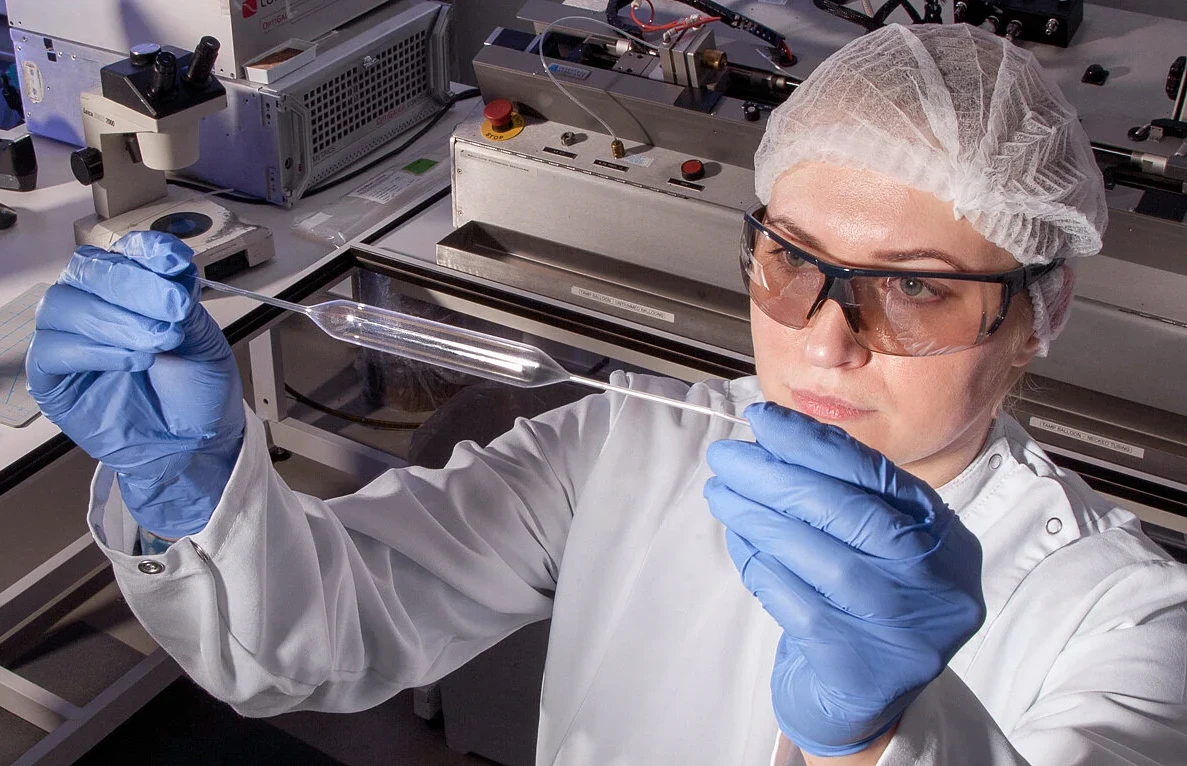
A balloon catheter is only as good as the balloon membrane, and the membrane is only as good as the forming process that made it. Most contract manufacturers buy balloons from a specialist and bond them to a shaft, which leaves wall thickness, burst behaviour and folded profile outside their control. A balloon catheter CDMO that forms its own balloons can treat those properties as design parameters, trade them against each other for the clinical target and validate the result under one quality system.
Envaste runs the full chain in-house: material and compliance selection, Pebax® and nylon shaft extrusion, stretch-blow balloon forming, radiopaque marker band placement, hydrophilic coating, burst and leak testing, and assembly, labelling and pouch sealing in an ISO Class 7 cleanroom. Design transfer and IQ/OQ/PQ validation run under ISO 13485, with regulatory support for 510(k), CE marking, MDR and MDSAP documentation.
The platform serves urology and endoscopy, where Envaste manufactures its own dilatation range, and the same processes build PTCA, PTA and ENT balloon catheters. The equipment behind each step is described on our catheter CDMO and contract manufacturing capabilities page.
Stretch-Blow Balloon Forming In-House
Balloons are formed by stretch-blow moulding from extruded parison tubing in non-compliant, semi-compliant and compliant configurations, with diameters from 0.5 mm to 50 mm for PTCA, PTA, urology and endoscopy applications. The forming process is controlled for three properties that decide whether a balloon crosses a tight stricture or lesion and survives repeated inflation:
- Consistent wall thickness along the cylinder and at the shoulders. On a 5 Fr shaft the inflated wall can be as thin as 15 to 30 µm, and a thickness variation above 15 percent at the shoulder welds is the most common cause of premature rupture in burst testing.
- High burst resistance at the rated pressure, delivered by the biaxial orientation the stretch-blow process puts into the polymer rather than by extra wall.
- Low folded profile, so the deflated balloon tracks through the access route and refolds predictably after inflation.
Balloon geometry, shoulder angle and cone length are set in the mould for each programme, and the same forming line serves development quantities and production lots so that validated parameters carry straight through to scale-up.
Balloon Materials and Compliance Selection
Material selection fixes the compliance profile, burst pressure, wall thickness, crossing profile and rated burst pressure of the device, so it is the first design decision in any balloon catheter programme. A compliant balloon keeps growing in diameter as pressure rises beyond nominal and conforms to variable anatomy; a non-compliant balloon reaches a fixed diameter at rated pressure and resists further expansion, which maximises radial force for tight strictures.
| Material | Compliance | Pressure range | Typical use |
|---|---|---|---|
| Nylon 12 (polyamide) | Semi-compliant | 6 to 20 ATM | Ureteral dilatation, general-purpose high-pressure balloons |
| PET | Non-compliant | 8 to above 30 ATM | Tight strictures, fixed-diameter dilatation |
| Pebax® (PEBA) | Semi-compliant to compliant | 2 to 12 ATM | Low-pressure access in flexible anatomy |
| Polyurethane | Compliant | 1 to 6 ATM | Occlusion balloons, gentle tissue contact |
| Irradiated PVC | Compliant | 1 to 5 ATM | Cost-sensitive low-pressure applications |
For dilatation of the ureter, semi-compliant nylon gives the best balance of predictable expansion and burst resistance up to 20 ATM, which is the construction Envaste uses in its own range. The material science is covered in depth in the balloon catheter engineering guide.
Shaft Extrusion, Guidewire Lumen, Marker Bands and Coating
The shaft carries the inflation lumen and the guidewire lumen in a dual-lumen or coaxial construction extruded in Pebax® or nylon, with multi-layer jackets and multi-durometer sections where the design needs a stiff proximal push section and a flexible distal segment. Guidewire compatibility is specified at 0.014, 0.018, 0.035 or 0.038 inch depending on the application, and braid reinforcement is embedded where kink resistance at the balloon shoulder or hub transition is a failure mode.
Platinum or platinum-iridium marker bands are swaged or bonded under the balloon shoulders so that the working length is visible under fluoroscopy, and the inflation lumen is sized so that inflation and deflation times meet the procedural requirement. A hydrophilic coating is applied on our own line where the device must track through a sheath or scope channel, and is tested for wet coefficient of friction and for durability after wipe cycling and sterilisation.
Shoulder welds and tip bonds are made by thermal and laser processes with controlled parameters, because weld-zone thickness and bond strength are where a balloon catheter fails first in burst and tensile testing.
Pressure Ratings, Burst Testing and Validation
A balloon catheter is specified by three pressures: the nominal working pressure at which it reaches its labelled diameter, the rated burst pressure that is printed on the label, and the mean burst pressure from destructive testing that is never reached in use. The rated burst pressure is a statistical claim, the pressure at which fewer than 0.1 percent of balloons fail, derived from the mean and standard deviation of burst data, and the mean burst must exceed it by an engineering margin of at least 20 to 25 percent.
The verification matrix for a balloon catheter programme covers:
- Dimensional verification of outer diameter, working length, balloon diameter at nominal pressure and shoulder wall thickness on ten samples per lot.
- Burst pressure testing at a controlled ramp of 1 ATM per second on ten samples, with mean and standard deviation used to set the statistical rated burst pressure.
- Leak testing at the rated burst pressure for 60 seconds with no more than 5 percent decay, at ambient and at 37 °C.
- Guidewire trackability and pull-through over the full catheter length with the force-displacement curve recorded.
- Coating lubricity and durability by wet coefficient of friction before and after wipe cycling and sterilisation.
- Simulated use through an anatomically representative model, including inflation to nominal and rated pressure, deflation and withdrawal.
Test methods and acceptance criteria are written into the design history file, so the technical documentation for submission is produced by the development programme rather than reconstructed from it. The full test matrix is described in the engineering guide's validation section.
Proof of the Platform: Envaste's Own Balloon Range
A CDMO client receives the same processes, test methods and cleanroom that build Envaste's own CE-marked balloon dilators. Each of these devices was taken from concept through design verification, validation and commercial production on the platform described above.
Ureteral Balloon Dilator (Tahina™)
12 to 18 Ch semi-compliant nylon balloons in 4, 6 and 10 cm lengths on a 5.8 F shaft, rated to 20 ATM over a 0.038-inch guidewire.
Ureteroscopy Balloon Dilator (Tahina™)
Through-the-scope dilator on a 3.5 Fr shaft that passes a 5 Fr working channel, 12 or 15 Ch balloons rated to 20 ATM.
Nephrostomy Balloon Dilator (Tahina™)
Non-compliant 24 and 30 Ch tract dilatation balloons rated to 17 ATM with an integrated radiopaque PTFE Amplatz sheath.
Multi-Stage Oesophageal Balloon Dilator (Amara™)
Three-stage through-the-scope GI dilatation balloons, also available wire-guided, built on the same forming and shaft platform.
From Concept to Design Transfer and Scale-Up
1. Feasibility
Target diameters and pressures, access route and any existing specification are reviewed for material, balloon geometry, shaft construction and tolerances.
2. Prototyping
Development moulds and extrusion tooling produce bench samples so that compliance curve, burst margin and folded profile can be measured before the design is frozen.
3. Design verification
The frozen design runs the dimensional, burst, leak, trackability, coating and simulated-use matrix, with methods and acceptance criteria recorded in the design history file.
4. Design transfer and production
IQ/OQ/PQ validation moves the device into the ISO Class 7 cleanroom for assembly, testing, labelling and pouch sealing, with statistical process control on forming and extrusion outputs.
Assembly takes place in a validated ISO Class 7 cleanroom of 1,500 sq ft split into two independent rooms, with gowning and material stores at ISO Class 8. The same system is described on the ISO 13485 quality system page.
Balloon Catheter CDMO — Frequently Asked Questions
Does Envaste form balloons in-house or buy them in?
In-house. Balloons are stretch-blow moulded on our own equipment in non-compliant, semi-compliant and compliant configurations with diameters from 0.5 mm to 50 mm. Forming the balloon ourselves is what lets us control wall thickness, burst resistance and folded profile as design parameters rather than accept them from a supplier.
Which balloon materials does a balloon catheter CDMO choose between?
Nylon 12 for semi-compliant balloons in the 6 to 20 ATM range, PET for non-compliant balloons from 8 to above 30 ATM, Pebax for semi-compliant to compliant balloons at 2 to 12 ATM, and polyurethane or irradiated PVC for compliant low-pressure balloons. The choice sets the compliance curve, rated burst pressure, wall thickness and crossing profile of the finished device.
How is the rated burst pressure of a balloon catheter established?
Balloons are pressurised to failure at a controlled ramp rate on samples of ten per lot. The mean and standard deviation of the burst data give a statistical rated burst pressure at which fewer than 0.1 percent of balloons fail, and the mean burst must exceed that rating by an engineering margin of at least 20 to 25 percent. Leak testing holds the balloon at the rated pressure for 60 seconds with no more than 5 percent decay.
Can Envaste manufacture vascular as well as urology balloon catheters?
Yes. The stretch-blow forming, extrusion, marker band and coating processes are the same platform. Envaste's own range is urology and endoscopy, and the design services cover PTCA semi-compliant and non-compliant catheters, PTA vascular catheters and ENT balloon catheters with 0.014, 0.018, 0.035 and 0.038 inch guidewire compatibility.
What proof of the balloon platform exists?
Envaste's own CE-marked devices are built on it: the Tahina™ ureteral balloon dilator rated to 20 ATM, the Tahina™ ureteroscopy balloon dilator on a 3.5 Fr through-the-scope shaft, the Tahina™ nephrostomy balloon dilator at 17 ATM with an integrated Amplatz sheath, and the Amara™ multi-stage oesophageal balloon dilators. A CDMO client receives the same processes, test methods and cleanroom.
How does a balloon catheter programme start?
Share the clinical requirement, target pressures and diameters, and any existing specification or design history. We come back with a feasibility view on material, balloon geometry, shaft construction and tolerances, and the stage at which the programme should enter, from concept through design verification to design transfer and ISO 13485 production.
Explore Further
Steerable Catheter CDMO
1-way to 4-way deflection with pull wires and laser-cut hypotubes on reinforced multi-lumen shafts, from concept to design transfer.
Balloon Catheter Engineering Guide
Materials, shaft extrusion, kink resistance, coatings and the full pressure and validation test matrix, written by the same team.
Catheter CDMO & Contract Manufacturing Capabilities
The extrusion, balloon forming, braiding, coating and cleanroom equipment behind every programme.
Catheter Design Services
Steerable, balloon, implant delivery, introducer sheath and ENT catheter development from concept to design transfer.
Have a Balloon Catheter to Develop or Transfer?
Share the target diameters, pressures and access route, or the existing specification, and our engineering team will come back with a feasibility view and a proposed programme.
Get In Touch