
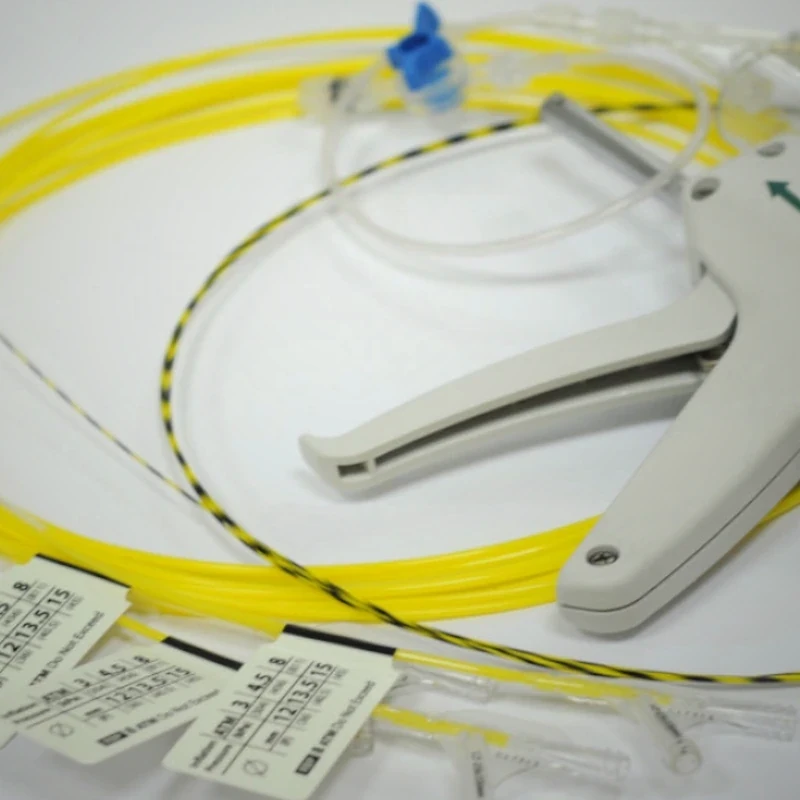
Wire-Guided Multi-Stage Balloon DilatorAmara™ Wireguided Balloon Dilatation Catheter · Over-the-Wire, 3-Stage
For strictures too tight or too angulated to cannulate directly. The wire-guided Amara™ tracks over a 0.035" guide wire to reach the lesion, then delivers three distinct diameters at three set pressures — oesophagus, pylorus, papilla or colon — without exchanging devices.
Wire-Guided Balloon Dilator Features
- Over-the-wire delivery on guide wires up to 0.035", under direct visualisation or fluoroscopy, for strictures that cannot be crossed under vision alone.
- Supplied with guidewire stylet, stopcock and clamp — wire access, inflation control and fixation in a single pack.
- Radiopaque marker band to confirm balloon position across the stricture during fluoroscopy.
- High column strength shaft for pushability and torque control when tracking through angulated or tortuous anatomy.
- Controlled radial balloon expansion designed to produce 3 distinct and precise diameters at 3 separate pressures during dilatation.
- High pressure balloon resistance designed to produce no balloon waisting.
- Through-the-scope placement from a 2.8 mm working channel (3.2 mm for the 18-19-20 mm balloon), in 180 cm and 240 cm lengths.
Need a custom configuration or a private-label version? Explore our catheter design services, or see our ISO 13485 catheter manufacturing capabilities.


When to Choose Wire-Guided Over Fixed-Wire
- The stricture is tight, angulated or tortuous and the balloon risks buckling without wire support.
- The lumen beyond the narrowing cannot be seen, so the stricture cannot be crossed under direct vision.
- Fluoroscopic confirmation of position is required before inflation.
- Access across the lesion must be preserved between exchanges or across a multi-session dilation programme.
- The stricture is short, straight and can be crossed under direct endoscopic vision.
- Fluoroscopy is not needed and the whole dilation is performed under vision.
- Fewer components in the field and a simpler set-up are preferred for a routine dilation.
See the Multi-Stage Oesophageal Balloon Dilator (Amara™) — same balloon platform, same three diameters, without the guidewire accessories.
Wire-Guided Balloon Diameters and Accessories
Balloon sizes: 6-7-8, 8-9-10, 10-11-12, 12-13.5-15, 15-16.5-18 and 18-19-20 mm. Balloon lengths 3.0 cm and 5.5 cm, catheter lengths 180 cm and 240 cm, guide wire compatibility to 0.035".
| Reference Part Number |
Inflated Balloon Diameter |
Balloon Length |
Inflated Pressure |
Catheter Length |
Minimum Working Channel |
Guidewire Size |
Accessories Supplied |
|---|---|---|---|---|---|---|---|
| GDB-0210630S | 6-7-8MM | 3.0CM | 3-6-10ATM | 180CM | 2.8MM | 0.035" | Stylet, Clamp, Stopcock |
| GDB-0210655S | 6-7-8MM | 5.5CM | 3-6-10ATM | 180CM | 2.8MM | 0.035" | Stylet, Clamp, Stopcock |
| GDB-0210830S | 8-9-10MM | 3.0CM | 3-5.5-9ATM | 180CM | 2.8MM | 0.035" | Stylet, Clamp, Stopcock |
| GDB-0210855S | 8-9-10MM | 5.5CM | 3-5.5-9ATM | 180CM | 2.8MM | 0.035" | Stylet, Clamp, Stopcock |
| GDB-0211030S | 10-11-12MM | 3.0CM | 3-5-8ATM | 180CM | 2.8MM | 0.035" | Stylet, Clamp, Stopcock |
| GDB-0211055S | 10-11-12MM | 5.5CM | 3-5-8ATM | 180CM | 2.8MM | 0.035" | Stylet, Clamp, Stopcock |
| GDB-0211230S | 12-13.5-15MM | 3.0CM | 3-4.5-8ATM | 180CM | 2.8MM | 0.035" | Stylet, Clamp, Stopcock |
| GDB-0211255S | 12-13.5-15MM | 5.5CM | 3-4.5-8ATM | 180CM | 2.8MM | 0.035" | Stylet, Clamp, Stopcock |
| GDB-0211555S | 15-16.5-18MM | 5.5CM | 3-4.5-7ATM | 180CM | 2.8MM | 0.035" | Stylet, Clamp, Stopcock |
| GDB-0211855S | 18-19-20MM | 5.5CM | 3-4.5-6ATM | 180CM | 3.2MM | 0.035" | Stylet, Clamp, Stopcock |
| GDB-0220630S | 6-7-8MM | 3.0CM | 3-6-10ATM | 240CM | 2.8MM | 0.035" | Stylet, Clamp, Stopcock |
| GDB-0220655S | 6-7-8MM | 5.5CM | 3-6-10ATM | 240CM | 2.8MM | 0.035" | Stylet, Clamp, Stopcock |
| GDB-0220830S | 8-9-10MM | 3.0CM | 3-5.5-9ATM | 240CM | 2.8MM | 0.035" | Stylet, Clamp, Stopcock |
| GDB-0220855S | 8-9-10MM | 5.5CM | 3-5.5-9ATM | 240CM | 2.8MM | 0.035" | Stylet, Clamp, Stopcock |
| GDB-0221030S | 10-11-12MM | 3.0CM | 3-5-8ATM | 240CM | 2.8MM | 0.035" | Stylet, Clamp, Stopcock |
| GDB-0221055S | 10-11-12MM | 5.5CM | 3-5-8ATM | 240CM | 2.8MM | 0.035" | Stylet, Clamp, Stopcock |
| GDB-0221230S | 12-13.5-15MM | 3.0CM | 3-4.5-8ATM | 240CM | 2.8MM | 0.035" | Stylet, Clamp, Stopcock |
| GDB-0221255S | 12-13.5-15MM | 5.5CM | 3-4.5-8ATM | 240CM | 2.8MM | 0.035" | Stylet, Clamp, Stopcock |
| GDB-0221555S | 15-16.5-18MM | 5.5CM | 3-4.5-7ATM | 240CM | 2.8MM | 0.035" | Stylet, Clamp, Stopcock |
| GDB-0221855S | 18-19-20MM | 5.5CM | 3-4.5-6ATM | 240CM | 3.2MM | 0.035" | Stylet, Clamp, Stopcock |
What the Stylet, Clamp and Stopcock Do
Every Amara™ wire-guided reference ships with three accessories, and each solves a specific problem in the wire-guided workflow rather than being a generic inclusion.
- •Guidewire stylet — occupies the wire lumen during insertion, so the catheter tracks the channel with the stiffness of a fixed-wire device and the lumen stays patent until the wire is needed
- •Clamp — fixes the guidewire relative to the catheter, so the wire does not migrate forward into the stricture or back out of position while the balloon is being advanced or inflated
- •Stopcock — holds inflation pressure at a step without the operator maintaining force on the syringe, which is what makes a timed hold at a given diameter practical
Supplying all three in the pack matters more than it sounds: a wire-guided dilatation improvised with whatever clamp and stopcock are on the trolley is where wire position tends to be lost.
Keeping Wire Access Through an Exchange
The reason to run over a wire is not the dilatation itself — it is everything that might follow it. Once a guidewire is across a tight or angulated stricture, that wire is the hard-won part of the procedure. A fixed-wire balloon withdrawn from the channel takes its access with it; a wire-guided balloon leaves the wire in place.
That matters when the first balloon range turns out to be wrong, when a stricture needs a second device, or when dilatation is followed by stent placement through the same track. Each exchange over a retained wire costs a catheter swap; each exchange without one costs re-cannulating a stricture that has just been dilated and may now bleed or be oedematous.
The trade-off is that wire-guided placement is a slightly longer set-up, which is why both options exist — the Oesophageal Balloon Dilator (Amara™) remains the more direct choice for a straightforward stricture seen clearly on the scope.
Matching the Reference to Your Endoscope
Twenty references span six three-stage diameter ranges, from 6-7-8 mm to 18-19-20 mm, in balloon lengths of 3.0 cm and 5.5 cm. Two figures determine which will physically work with your scope.
Minimum working channel is 2.8 mm for the smaller ranges and 3.2 mm for the larger. Catheter length is 180 cm for gastroscopy or 240 cm for colonoscopes and enteroscopes. A wire-guided device makes the length question slightly more pointed than it is for a fixed-wire balloon, because the guidewire has to be long enough to retain access while the catheter is withdrawn over it — a short wire with a long catheter leaves nothing to hold.
Guidewire compatibility is up to 0.035" across the range, and each reference carries a radiopaque marker band for fluoroscopic confirmation where the stricture cannot be fully seen endoscopically.