

Ureteroscopy Balloon DilatorTahina™ Ureteroscopy Catheter
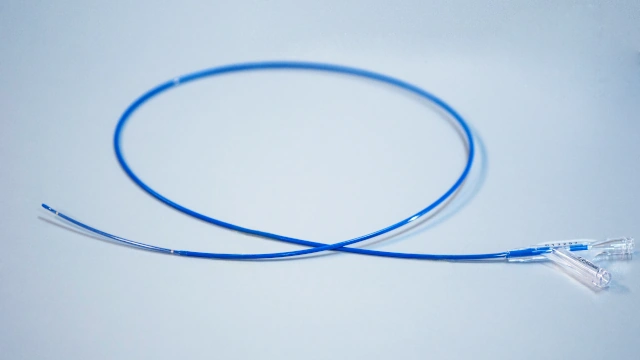
The high pressure Tahina™ ureteroscopy dilatation balloons are available in 12Ch or 15Ch sizes. Consistent balloon expansion for universal dilatation of the ureter. Radiopaque markers aid with balloon placement. Premium balloon pressure ratings up to 20 ATM.
Ureteroscopy Balloon Dilator Features
- Hydrophilic coating on the balloon and shaft distal end.
- Tapered tip with rounded end for atraumatic introduction.
- Low profile shaft to be inserted inside 5Fr ureteroscope channel.
- Designed with kink resistant shaft to facilitate insertion into tight, tortuous ureteral tract.
- Controlled inflation pressure up to 20ATM facilitating high pressure dilation of narrow strictures.
- Radiopaque marker band to confirm placement during fluoroscopy.
Need a custom configuration or a private-label version? Explore our catheter design services, or see our ISO 13485 catheter manufacturing capabilities.

TTS Balloon Diameters and Rated Pressures
| Reference Part Number |
Inflated Balloon Diameter |
Balloon Length | Rated Burst Pressure |
Catheter Length |
Guidewire |
|---|---|---|---|---|---|
| UDB-0204040S | 12Ch (4.0MM) | 4CM | 20ATM | 75CM | 0.018" |
| UDB-0205040S | 15Ch (5.0MM) | 4CM | 20ATM | 75CM | 0.018" |
TTS Dilatation Through a 5 Fr Working Channel
A through-the-scope balloon — usually shortened to TTS — is a dilator slim enough to pass down the working channel of a ureteroscope that is already in position. The alternative is to withdraw the scope, place a dilator over a wire, dilate, then re-advance the scope. TTS dilatation removes that exchange entirely.
The Tahina™ Ureteroscopy Balloon Dilator is built for a 5 Fr working channel on a 3.5F shaft. That clearance is what makes the technique practical: the balloon goes down the channel, across the stricture, and inflates under the vision you already have, with the scope tip held steady at the segment being dilated.
The practical gains are the ones that matter in a long case — fewer passes through the uretero-vesical junction, less cumulative ureteral trauma from scope exchanges, and a shorter procedure. Our clinical guide covers the technique and its indications in best practices for ureteral dilatation.
Low-Profile Shaft and 0.018-Inch Guidewire
Everything about this catheter follows from the channel it has to fit. A 3.5F shaft inside a 5 Fr working channel leaves very little room, and the guidewire has to shrink with it: the Tahina™ Ureteroscopy dilator runs on a 0.018" wire, not the 0.038" used by over-the-wire dilators and access sheaths.
That difference is worth planning for. If the case begins over a 0.038" wire and a stricture is then found that calls for TTS dilatation, the smaller wire is a separate item — it is not interchangeable with the one already placed. Keeping an 0.018" wire on the trolley alongside the TTS balloon avoids discovering the mismatch mid-case.
Despite the reduced profile, the shaft is kink-resistant, so it still tracks a tight, tortuous tract rather than buckling proximal to the resistance, and a radiopaque marker band confirms balloon position across the stricture before inflation.
Choosing Between the 12Ch and 15Ch Balloon
The range is deliberately short: two references, 12Ch (4.0 mm) and 15Ch (5.0 mm), both with a 4 cm balloon on a 75 cm catheter, both rated to 20 ATM.
- •12Ch (4.0 mm) — for a tight uretero-vesical junction or a first dilatation where the objective is passage rather than a wide lumen
- •15Ch (5.0 mm) — where the segment needs to admit instruments afterwards, or where a previous dilatation has recurred
The single 4 cm balloon length reflects what TTS dilatation is for. A balloon reached through the scope is addressing a focal stricture or a tight junction found during the procedure — a long-segment stricture is a planned, over-the-wire problem, and the Ureteral Balloon Dilator (Tahina™) carries 6 cm and 10 cm balloons for exactly that.
Both references are rated to the full 20 ATM, so neither size trades pressure for profile.
When a TTS Balloon Saves the Case
The scenario a TTS balloon is built for is the one you did not plan: the scope is in, and a stricture or tight junction stops it going further. Without a through-the-scope option the choices are to withdraw and convert to over-the-wire dilatation, or to abandon and stage the procedure.
Typical situations where the TTS route is the better one:
- •A tight uretero-vesical junction found on scope advancement, where the rest of the ureter is unremarkable
- •A focal distal stricture discovered mid-case that was not visible on pre-operative imaging
- •An unstented ureter that will not accept an access sheath without dilatation first
- •Cases where repeated scope passes are themselves the risk — a long procedure, or a ureter already showing mucosal injury
Where dilatation is planned from the outset, the over-the-wire dilator remains the straightforward choice. The TTS balloon earns its place by removing the exchange when the problem appears after the scope is already where it needs to be.