

Ureteral Balloon DilatorTahina™ Ureteral Catheter
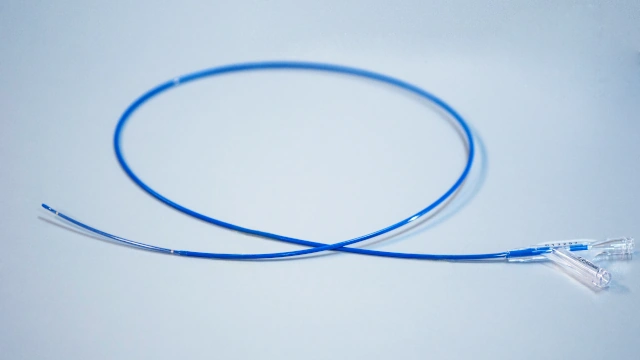
The high pressure Tahina™ ureteral dilatation balloons are available in a wide range of sizes. Consistent balloon expansion for universal dilatation of the ureter. Radiopaque markers aid with balloon placement. Premium balloon pressure ratings up to 20 ATM.
Ureteral Balloon Dilator Features
- Hydrophilic coating on the balloon and shaft distal end.
- Tapered tip with rounded end for atraumatic introduction.
- Controlled inflation pressure up to 20ATM facilitating high pressure dilation of narrow strictures.
- Designed with kink resistant shaft to facilitate insertion into tight, tortuous ureteral tract.
- Delivery over guidewires up to 0.038" under direct visualization or fluoroscopy.
- Radiopaque marker band to confirm placement during fluoroscopy.
Need a custom configuration or a private-label version? Explore our catheter design services, or see our ISO 13485 catheter manufacturing capabilities.

Balloon Diameters, Lengths and Burst Pressures
| Reference Part Number |
Inflated Balloon Diameter |
Balloon Length | French Size | Rated Burst Pressure |
Catheter Length |
Guidewire |
|---|---|---|---|---|---|---|
| UDB-0104040S | 12Ch (4.0MM) | 4CM | 5.8F | 20ATM | 75CM | 0.038" |
| UDB-0104060S | 12Ch (4.0MM) | 6CM | 5.8F | 20ATM | 75CM | 0.038" |
| UDB-0104100S | 12Ch (4.0MM) | 10CM | 5.8F | 18ATM | 75CM | 0.038" |
| UDB-0105040S | 15Ch (5.0MM) | 4CM | 5.8F | 20ATM | 75CM | 0.038" |
| UDB-0105060S | 15Ch (5.0MM) | 6CM | 5.8F | 20ATM | 75CM | 0.038" |
| UDB-0105100S | 15Ch (5.0MM) | 10CM | 5.8F | 18ATM | 75CM | 0.038" |
| UDB-0106040S | 18Ch (6.0MM) | 4CM | 5.8F | 20ATM | 75CM | 0.038" |
| UDB-0106060S | 18Ch (6.0MM) | 6CM | 5.8F | 20ATM | 75CM | 0.038" |
| UDB-0106100S | 18Ch (6.0MM) | 10CM | 5.8F | 18ATM | 75CM | 0.038" |
Matching Balloon Diameter to the Stricture
The Tahina™ Ureteral Balloon Dilator is supplied in three inflated diameters, quoted in both Charrière and millimetres because ureteral dilatation is discussed in both:
- •12Ch (4.0 mm) — the conservative choice for a first dilatation, or where the ureter distal to the stricture is itself narrow
- •15Ch (5.0 mm) — the common working diameter, sufficient to admit most ureteroscopes and access sheaths after dilatation
- •18Ch (6.0 mm) — the largest in the range, for established strictures where a wider lumen is the objective rather than simply passage
Diameter should be chosen against what the ureter was, not what the instrument needs. Over-dilating a segment beyond its native calibre adds no benefit and increases the risk of wall injury, while under-dilating leaves a residual waist that tends to recur.
Stricture aetiology, length and degree of fibrosis all bear on this decision, and they are set out with the corresponding pressure requirements in our clinical guide to best practices for ureteral dilatation.
Balloon Length and Rated Pressure
Balloon lengths of 4, 6 and 10 cm cover focal through to long-segment strictures. The balloon should be long enough that the stricture sits well within the working length, so the waist is dilated rather than the balloon simply migrating past it under pressure.
One detail is worth noting before ordering: the 4 cm and 6 cm balloons are rated to 20 ATM, while the 10 cm balloon is rated to 18 ATM. That is a consequence of geometry rather than a difference in construction — hoop stress in a cylindrical balloon rises with surface area at a given pressure, so a longer balloon reaches its rated limit sooner. If a long-segment stricture is also densely fibrotic and likely to need the top of the pressure range, a shorter balloon repositioned along the segment gives more headroom than a single 10 cm inflation.
All references share a 5.8F shaft, a 75 cm catheter length and compatibility with guidewires up to 0.038". Nine references in total cover the three diameters across the three lengths.
Tahina™ Ureteral or Through-the-Scope Dilator
Envaste makes two ureteral dilators, and the choice is about access route rather than performance.
Tahina™ Ureteral — over the wire
- • Delivered over a 0.038" guidewire, 5.8F shaft
- • Up to 20 ATM for dense or established strictures
- • Balloon diameters to 6.0 mm
- • Used before scope or sheath passage
Tahina™ Ureteroscopy — through the scope
- • 3.5F shaft, passes a 5 Fr working channel
- • Scope stays in position during dilatation
- • Suited to a distal stricture or tight UVJ found mid-case
- • Avoids a scope exchange and its repeat trauma
In practice the over-the-wire dilator is planned in advance from imaging, while the through-the-scope balloon solves a problem discovered during ureteroscopy. See the Ureteroscopy Balloon Dilator (Tahina™) for the low-profile option, or the Nephrostomy Balloon Dilator (Tahina™) for percutaneous tract dilatation.
Using the Dilator with an Access Sheath
Balloon dilatation and access sheath placement are usually consecutive steps in the same case: the stricture or tight uretero-vesical junction is dilated first, then a sheath is advanced through the segment that has just been opened. Both the Tahina™ dilator and the Manawa™ access sheaths run over a guidewire of up to 0.038", so the wire placed for dilatation stays in position and carries the sheath afterwards without re-cannulating.
Diameter selection links the two decisions. A 15Ch (5.0 mm) dilatation comfortably precedes the mid-range access sheaths; if the plan is a larger sheath, the dilatation diameter has to account for the sheath's outer diameter rather than its inner lumen.
See the Ureteral Access Sheath (Manawa™) for the passive-drainage range, or the FANS Suction Ureteral Access Sheath (Manawa™) where intrarenal pressure control is the priority.
Preparation and Inflation
The dilator is delivered over a guidewire under direct visualisation or fluoroscopy. A tapered tip with a rounded end eases introduction, and the kink-resistant shaft is what allows the catheter to be pushed through a tight, tortuous tract without the shaft buckling proximal to the resistance — the usual failure mode when a balloon will not cross.
A radiopaque marker band confirms balloon position across the stricture before inflation begins. Inflation is then taken up with an indeflator so that pressure is both controlled and read, rather than estimated by syringe feel; the waist disappearing from the balloon profile under fluoroscopy is the endpoint that matters, not the pressure reached.
Rated burst pressure is a limit, not a target. Where a waist persists at rated pressure, the stricture is telling you something about its fibrosis density, and repeated inflation at the limit is less informative than reconsidering the approach — a point our clinical guide covers under complication avoidance.