
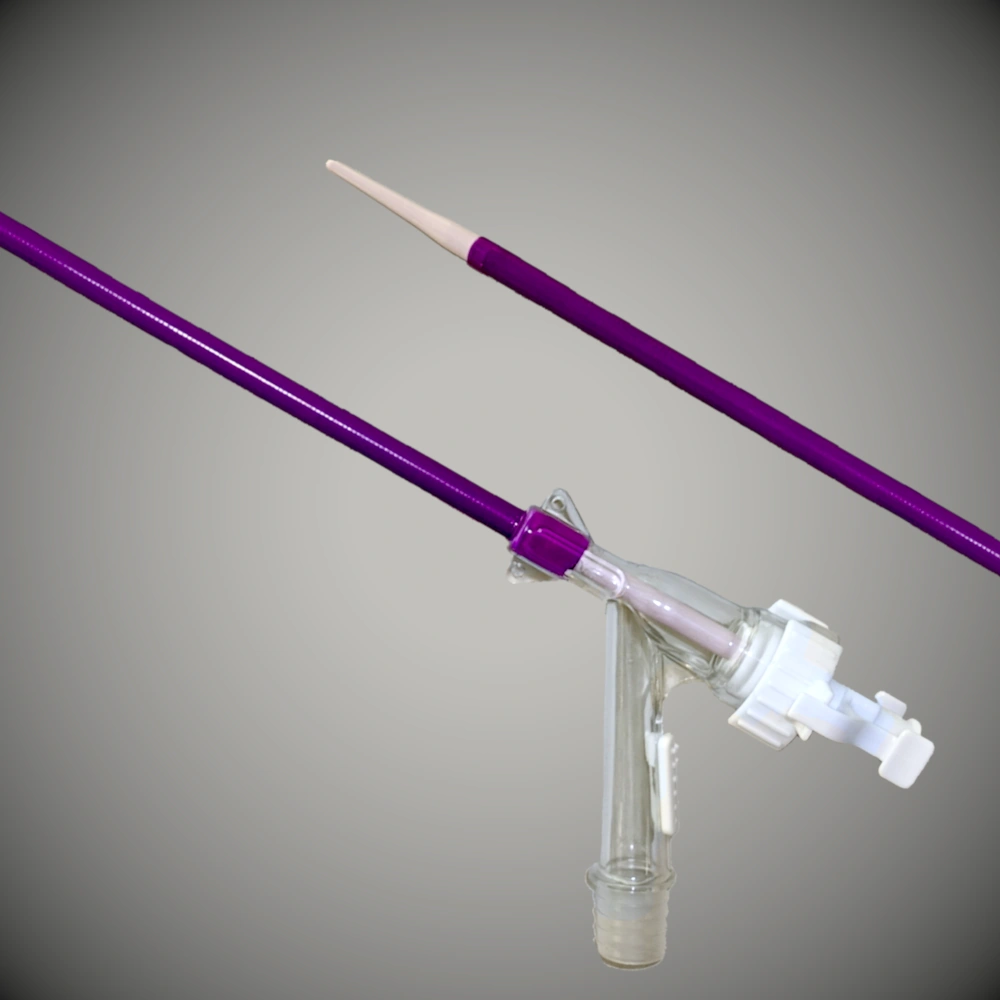
FANS Suction
Ureteral Access SheathManawa™ Suction
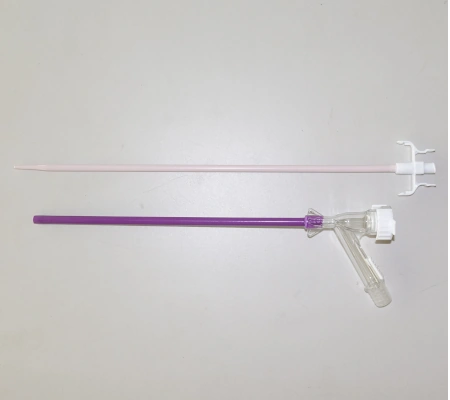
The flexible and navigable Manawa™ suction ureteral access sheath (FANS-UAS) reduces intrarenal pressure, improve vision, remove stone fragments and dust
Suction Ureteral Access Sheath Features
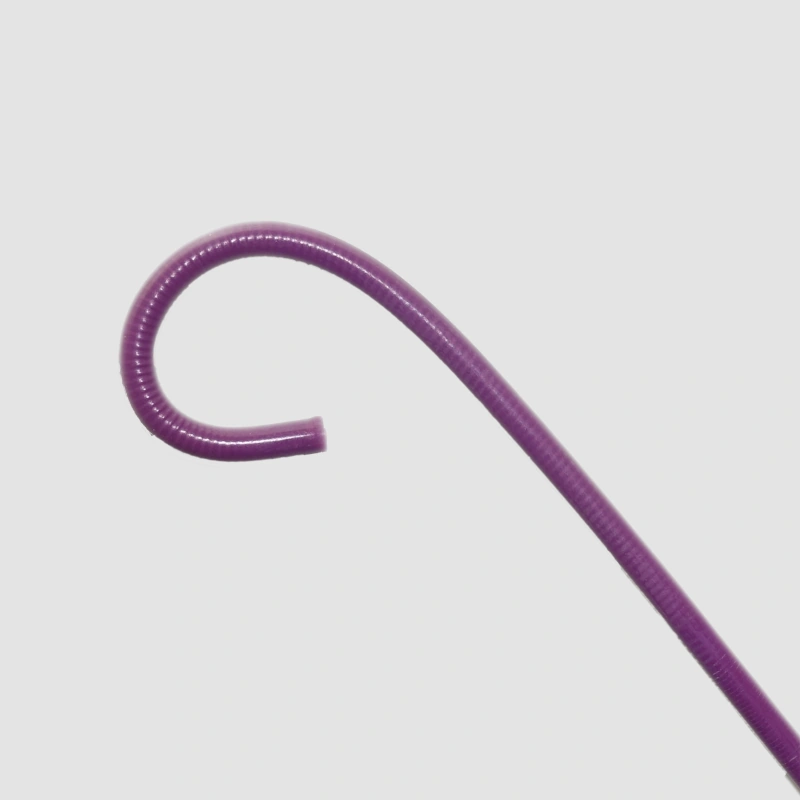
- Superior flexibility of the sheath distal end to access the kidney lower calyx.
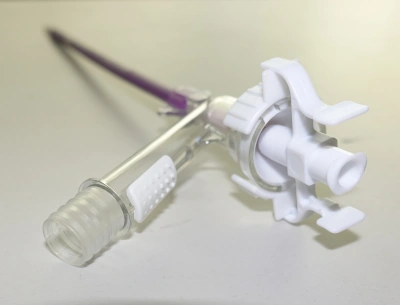
- Unique funnel-like cone design to facilitate scope entry, protecting your high-value optics from damage during insertion.
- Innovative valve design to ensure efficient suction control and pressure management.
- Manual control of the suction intensity via pressure ventilation slider.
- Hydrophilic coating on the dilator and sheath for smooth insertion.
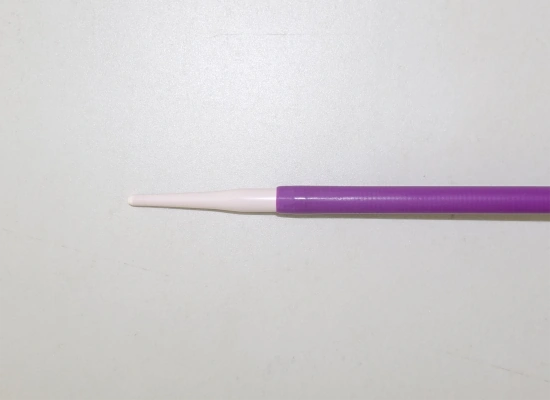
- Tapered dilator with rounded tip for atraumatic introduction.
- Seamless transition between dilator and sheath to reduce risks of trauma.
- Reinforced sheath to provide stability and strength during placement.
- Radiopaque marker band on the sheath tip to confirm placement during fluoroscopy.
Need a custom configuration or a private-label version? Explore our catheter design services, or see our ISO 13485 catheter manufacturing capabilities.
Suction Sheath Sizes and Working Lengths
| Reference Part Number |
Internal Diameter French Size |
External Diameter French Size |
Sheath Length | Tip Length | Guidewire | Hydrophilic Coating |
|---|---|---|---|---|---|---|
| UAS-0408020S | 8F | 10F | 20CM | 20MM | 0.038" | Dilator Tip & Sheath |
| UAS-0408028S | 8F | 10F | 28CM | 20MM | 0.038" | Dilator Tip & Sheath |
| UAS-0408035S | 8F | 10F | 35CM | 20MM | 0.038" | Dilator Tip & Sheath |
| UAS-0408045S | 8F | 10F | 45CM | 20MM | 0.038" | Dilator Tip & Sheath |
| UAS-0408055S | 8F | 10F | 55CM | 20MM | 0.038" | Dilator Tip & Sheath |
| UAS-0409520S | 9.5F | 11.5F | 20CM | 20MM | 0.038" | Dilator Tip & Sheath |
| UAS-0409528S | 9.5F | 11.5F | 28CM | 20MM | 0.038" | Dilator Tip & Sheath |
| UAS-0409535S | 9.5F | 11.5F | 35CM | 20MM | 0.038" | Dilator Tip & Sheath |
| UAS-0409545S | 9.5F | 11.5F | 45CM | 20MM | 0.038" | Dilator Tip & Sheath |
| UAS-0409555S | 9.5F | 11.5F | 55CM | 20MM | 0.038" | Dilator Tip & Sheath |
| UAS-0410720S | 10.7F | 12.7F | 20CM | 22MM | 0.038" | Dilator Tip & Sheath |
| UAS-0410728S | 10.7F | 12.7F | 28CM | 22MM | 0.038" | Dilator Tip & Sheath |
| UAS-0410735S | 10.7F | 12.7F | 35CM | 22MM | 0.038" | Dilator Tip & Sheath |
| UAS-0410745S | 10.7F | 12.7F | 45CM | 22MM | 0.038" | Dilator Tip & Sheath |
| UAS-0410755S | 10.7F | 12.7F | 55CM | 22MM | 0.038" | Dilator Tip & Sheath |
| UAS-0412020S | 12F | 14F | 20CM | 24MM | 0.038" | Dilator Tip & Sheath |
| UAS-0412028S | 12F | 14F | 28CM | 24MM | 0.038" | Dilator Tip & Sheath |
| UAS-0412035S | 12F | 14F | 35CM | 24MM | 0.038" | Dilator Tip & Sheath |
| UAS-0412045S | 12F | 14F | 45CM | 24MM | 0.038" | Dilator Tip & Sheath |
| UAS-0412055S | 12F | 14F | 55CM | 24MM | 0.038" | Dilator Tip & Sheath |
What FANS Means in Practice
FANS stands for Flexible Active-suction Navigable Sheath, and each word corresponds to a construction decision rather than a marketing claim. A conventional access sheath is a passive conduit: irrigation leaves the collecting system only through the annular gap around the scope. A FANS sheath adds a dedicated suction path, so outflow is driven rather than merely permitted.
- •Flexible — the distal end bends with the scope instead of resisting it, so deflection is preserved at the sheath tip
- •Active-suction — a vacuum channel evacuates irrigation and fragments continuously, decoupling outflow from irrigation rate
- •Navigable — a reinforced body with a tapered hydrophilic dilator, so the sheath still tracks a tortuous ureter
The practical consequence is that irrigation rate stops being the variable that governs pressure. With a passive sheath, raising flow to clear a cloudy field also raises intrarenal pressure; with active suction, the two are separated, and the surgeon can irrigate for visibility without the usual trade-off.
Choosing a Suction Sheath Size
The Manawa™ Suction range runs from 8F/10F to 12F/14F inner/outer diameter, across twenty references. Because the sheath carries both the scope and an active suction path, the inner diameter does more work here than on a passive sheath — it has to accommodate the scope while leaving a cross-section through which fragments can actually travel.
- •8F / 10F — the narrowest outer profile, for tight or unstented ureters where a larger sheath would meet resistance
- •9.5F / 11.5F and 10.7F / 12.7F — the usual working range with a standard flexible ureteroscope, balancing fragment clearance against ureteral load
- •12F / 14F — the largest clearance path, for heavy stone burden where fragment volume is the limiting factor
Working lengths run 20, 28, 35, 45 and 55 cm. The 55 cm option extends beyond the standard access sheath range and exists for tall patients and for anatomy where a 45 cm sheath leaves the tip short of the proximal ureter. Tip length scales from 20 to 24 mm with diameter, keeping the taper gradual across the range, and every reference accepts a guidewire of up to 0.038".
Controlling Suction During the Case
Suction is not a setting to apply at maximum and forget. Excessive vacuum can draw the walls of the collecting system onto the sheath tip, or pull the scope tip against the mucosa at the ureteropelvic junction — both of which cost visibility and risk mucosal trauma. The useful approach is to titrate: begin low, and increase as fragment load builds during lithotripsy.
The Manawa™ Suction sheath is built for that. A manual pressure-ventilation slider adjusts suction intensity in real time, without pausing the procedure or returning to the pump, and the valve is designed to control suction and pressure together rather than acting as a simple on/off port.
A leak-free valve matters more than it sounds. Any air ingress into the circuit breaks the vacuum, and a sheath that leaks delivers no useful suction no matter what the pump is set to. The valve design is what keeps the circuit intact through scope insertions and exchanges.
Lower Pole Access and Scope Deflection
Lower pole calculi demand maximum deflection from a flexible ureteroscope, and that is exactly where a rigid sheath tip interferes. If the distal end of the sheath will not bend, it braces against the scope at the ureteropelvic junction and limits how far the tip can articulate — the lower pole becomes harder to reach, or unreachable without withdrawing the sheath.
The flexible distal end of the Manawa™ Suction sheath is there to avoid that. It bends with the scope rather than against it, preserving deflection angle so the lower pole stays accessible without repositioning the sheath between calyces. For a suction sheath this matters twice over: the cases that most need active fragment clearance are often the ones with the widest calyceal spread.
At the proximal end, the funnel-shaped cone guides the scope into the sheath and shields the objective lens from contact during insertion and exchange — a practical consideration when a long case calls for several scope passes.
Fragment Clearance During Dusting
High-frequency, low-energy laser settings produce fine stone dust rather than retrievable fragments. Dust is slower to leave the collecting system through a passive annular gap than discrete pieces are, and while it is suspended the field stays cloudy — which tends to prompt more irrigation, which raises pressure further.
Active suction addresses the cause rather than the symptom: dust is drawn out as it is generated, so visibility is maintained without increasing inflow, and basketing is needed for fewer fragments. Pairing dusting settings with a suction sheath is the configuration in which both techniques work as intended.
The same logic applies to infection and struvite stones, where fragmentation releases bacteria into the collecting system and limiting both pressure and residence time is the priority. Our clinical guide to optimising intrarenal pressure during RIRS covers pre-operative risk stratification and intraoperative monitoring in detail.